Best tips to ace your HireVue interview in 2026
Key takeaways
- A HireVue interview is usually a structured screening round where you answer pre-set questions on video, often under a time limit.
- Most HireVue answers should be 60 to 120 seconds, unless the prompt gives a different limit.
- The best answers use a clear structure: direct answer, situation, action, result, and connection to the role.
- Practice out loud before the real interview. Silent preparation does not expose rambling, weak examples, or awkward camera delivery.
A HireVue interview can feel strange because there is often no person on the other side of the screen. You read a question, prepare for a short window, then record your answer. No nodding interviewer. No follow-up smile. No normal conversation rhythm.
That is why preparation matters.
A HireVue screening is not just a camera test. It is a first-round interview. The employer is trying to decide whether you are worth moving to the next stage. Your job is to make that decision easy by giving clear, specific, role-relevant answers.
What is a HireVue interview?
A HireVue interview is a digital interview used by employers to screen candidates. Depending on the company, it may include one-way video questions, live video interviews, written answers, games, technical assessments, or other screening tasks.
This guide focuses on the most common candidate concern: the one-way HireVue video interview.
In a one-way video interview, you usually answer pre-set questions on camera. You may get a practice round, a short preparation window, and a fixed amount of time to answer. The exact rules vary by employer, so always read the instructions before starting.
Do not click into the real interview casually. Once the real questions begin, some employers may not let you redo answers.
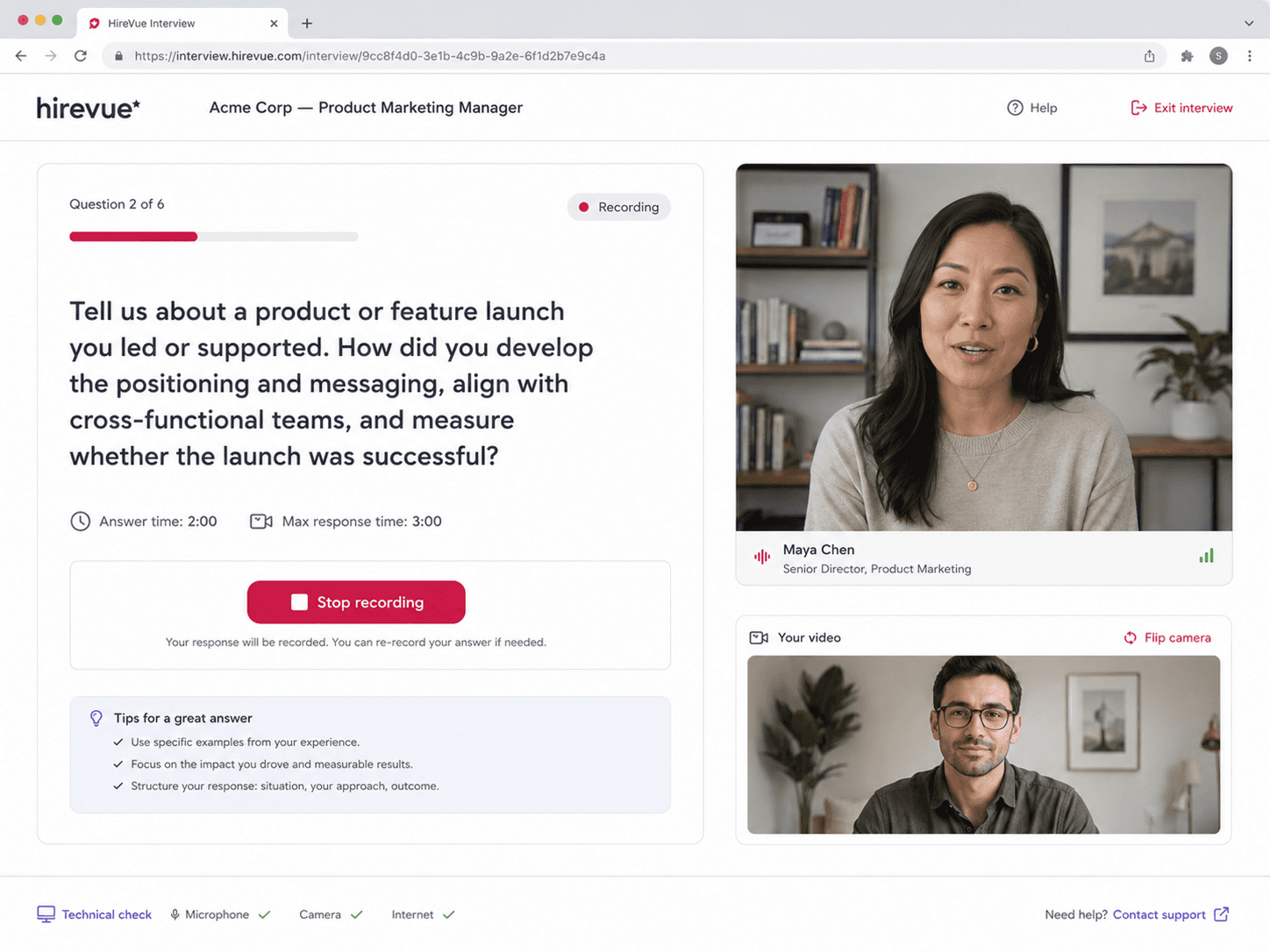
A HireVue screening round is easier when you have already practiced speaking answers out loud.
What HireVue is really testing
Most candidates obsess over the wrong thing. They ask, "How do I beat the HireVue algorithm?"
A better question is: "How do I make my fit obvious in a short recorded answer?"
Whether your video is reviewed by a recruiter, hiring manager, AI-assisted scoring system, or a mix of the above, the fundamentals are similar. A strong answer should show:
| What they are evaluating | What your answer needs to show |
|---|---|
| Role fit | You understand what the job requires |
| Communication | You can explain ideas clearly under pressure |
| Judgment | You make sensible decisions in realistic situations |
| Evidence | You have examples, not just claims |
| Motivation | You have a credible reason for wanting this role |
| Professionalism | You can present yourself well in a work context |
The safest strategy is to sound prepared, not rehearsed. That means you should know your stories, your role fit, and your key points before the interview starts.
The best HireVue answer structure
For most HireVue questions, use this structure:
- Start with the direct answer.
- Give brief context.
- Explain what you personally did.
- Share the result.
- Connect the answer back to the role.
This is based on the STAR method, but with one extra step at the end. The role connection matters because HireVue answers are short. You cannot assume the reviewer will connect the dots for you.
Example answer
Question: "Tell me about a time you worked under pressure."
Weak answer:
"I work well under pressure. In my last role things were always busy, so I had to multitask a lot and stay organized."
Better answer:
"One example was during a product launch when our weekly reporting dashboard broke two days before the leadership review. I owned the fix. I checked the source data, found that a tracking change had broken one of the conversion fields, rebuilt the query, and sent a clear explanation to the team. We were able to use the dashboard in the review, and it became the template for future launch reporting. That experience is relevant here because this role needs someone who can stay calm, diagnose problems quickly, and communicate clearly when the timeline is tight."
The second answer works because it gives proof. It shows the situation, your action, the result, and why it matters for the target role.
Common HireVue interview questions
You will not know every question in advance, but most HireVue screening questions fall into predictable categories.
Tell me about yourself
This question tests whether you can summarize your background in a way that matches the role.
Use this structure:
Current background → strongest relevant experience → why this role is the next logical stepAvoid giving your life story. Keep it job-relevant.
Why do you want this role?
This question tests whether you understand the job and have a real reason for applying.
A strong answer includes:
- One reason tied to the role responsibilities.
- One reason tied to the company, product, industry, or mission.
- One proof point from your background.
Do not say, "I want to grow" and stop there. Every candidate wants to grow. Explain why this role specifically fits your skills and direction.
Why do you want to work at this company?
This question tests whether you did real research.
Mention specifics:
- Product
- Customers
- Market position
- Recent company news
- Values
- Team mission
- Business model
- Problems the company is solving
Weak answer:
"I like your culture and think this is a great company."
Better answer:
"I am interested in this company because your product sits at the intersection of payments, risk, and customer experience. In my previous role, I worked on reducing friction in onboarding while keeping compliance requirements intact, so I am excited by the chance to work on similar tradeoffs at a larger scale."
Specific beats enthusiastic.
Tell me about a time you worked on a team
This question tests collaboration, communication, and role clarity.
Your answer should explain:
- What the team was trying to do.
- What your role was.
- Where collaboration was needed.
- What outcome the team achieved.
Do not make the answer sound like you did everything yourself. Show ownership without erasing the team.
Tell me about a time you handled conflict
This question tests maturity.
A strong conflict answer should not make you look dramatic. Pick a real disagreement, explain both sides fairly, then show how you moved the work forward.
Good conflict answers usually include:
- A disagreement about priorities, scope, data, timeline, or approach.
- A calm action you took.
- A resolution or lesson.
- A connection to how you work with others now.
Avoid blaming the other person. The employer is listening for how you behave when work gets uncomfortable.
Tell me about a time you failed
This question tests self-awareness.
Use a real failure, but not one that destroys trust for the role.
Structure it like this:
What went wrong → what you learned → what you changed → better result laterThe most important part is what changed after the failure.
Tell me about a time you had to make a quick decision
This question tests judgment under uncertainty.
Explain:
- What information you had.
- What information you did not have.
- How you made the decision.
- What happened.
- What you would do again or improve.
This is especially common in roles involving operations, product, customer support, finance, management, and fast-moving teams.
What is your greatest weakness?
This question tests honesty and self-management.
Do not use a fake weakness like "I work too hard."
Pick something real but manageable:
- Over-explaining.
- Taking too long to ask for help.
- Wanting too much information before making a decision.
- Being too detail-oriented in early drafts.
- Getting too deep into execution before aligning stakeholders.
Then explain what you are doing to improve.
What would you do in this situation?
This question tests practical judgment.
For situational questions, use this structure:
Clarify the goal → identify the risk → take the first sensible action → communicate → follow upExample:
"First, I would clarify the expected outcome and deadline. Then I would identify the biggest risk, communicate the tradeoff to the right stakeholder, and take the action that protects the customer or business impact first. After that, I would document what happened so the team can prevent the same issue next time."
Situational answers should sound calm and practical, not theoretical.
How long should HireVue answers be?
Most HireVue answers should be 60 to 120 seconds unless the prompt gives a different time limit. Use the limit as a ceiling, not a target.
If you have three minutes, you usually do not need to speak for the full three minutes. A strong answer is often 60 to 120 seconds. That is enough time to give context, action, result, and role connection without rambling.
| Question type | Good target length |
|---|---|
| Tell me about yourself | 60 to 90 seconds |
| Why this role? | 45 to 75 seconds |
| Behavioral story | 90 to 120 seconds |
| Situational judgment | 60 to 90 seconds |
| Technical explanation | Depends on complexity, but stay structured |
If you keep running out of time, your setup is probably too long. Start the action sooner.
How to prepare for a HireVue interview in 90 minutes
You do not need to memorize 50 answers. You need a small set of strong stories that can flex across many questions.
Step 1: Decode the job description
Read the job description and identify the top skills the employer is likely screening for.
Look for repeated signals:
- Leadership
- Teamwork
- Customer focus
- Problem-solving
- Data analysis
- Communication
- Attention to detail
- Ownership
- Adaptability
- Integrity
- Technical skills
- Sales ability
- Stakeholder management
Turn those signals into likely questions.
| Job description signal | Likely HireVue question |
|---|---|
| Cross-functional collaboration | Tell me about a time you worked with a difficult stakeholder. |
| Fast-paced environment | Tell me about a time you handled competing priorities. |
| Customer obsessed | Tell me about a time you solved a customer problem. |
| Data-driven | Tell me about a time you used data to make a decision. |
| Ownership | Tell me about a time you took initiative. |
Step 2: Build a story bank
Prepare 6 to 8 stories before the interview.
You want stories for:
- Leadership
- Teamwork
- Conflict
- Failure
- Problem-solving
- Working under pressure
- Learning quickly
- Customer or stakeholder impact
- Technical or role-specific success
- Integrity or judgment
For each story, write short bullets only.
Story: Fixed broken launch dashboard
Situation: Tracking issue before leadership review
Action: Audited source data, rebuilt query, explained issue
Result: Dashboard used in review, became recurring template
Shows: ownership, data quality, pressure, communication
Do not write a full script. Scripts make you stiff and increase the chance that you sound like you are reading.
Step 3: Prepare your company answer
For "Why this company?", prepare three specific points:
- What the company does.
- Why that matters to you.
- How your background connects to it.
A good company answer should not sound like it came from the first paragraph of the company website.
Use recent product launches, customer segments, market changes, mission, role responsibilities, or problems the team is solving.
Step 4: Practice out loud
Thinking through answers silently is not enough. HireVue is a speaking task. You need to practice speaking into a camera before the real interview.
Use CareerMax Interview Prep to create a screening round simulation for the role. Paste the job description, choose the interview type, and practice answering realistic screening questions out loud. CareerMax helps you test whether your answers are structured, specific, relevant to the role, and clear enough for an early screening round.
This is especially useful for HireVue because the format rewards candidates who can answer without needing interviewer feedback in the moment.
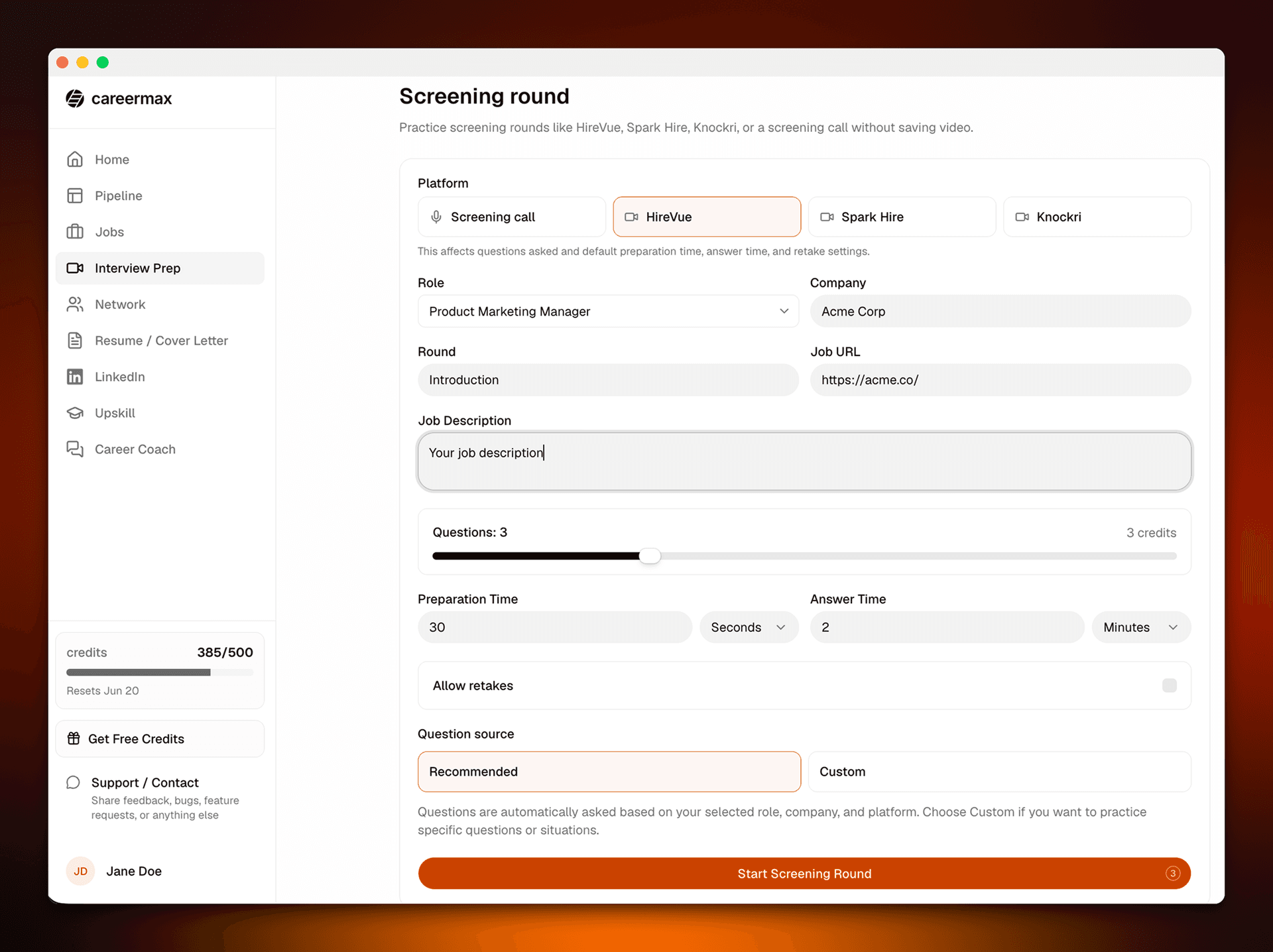
Use CareerMax to create a role-specific screening round simulation before taking the real HireVue interview.
Step 5: Run one timed practice round
Before the real interview, do one timed practice round.
Practice:
- One "tell me about yourself" answer.
- One "why this role" answer.
- Two behavioral stories.
- One situational question.
- One role-specific question.
Then review:
- Did you answer the question directly?
- Did you give a real example?
- Did you explain your personal role?
- Did you include a result?
- Did you connect the answer to the job?
- Did you sound natural?
If the answer is too long, cut the background. If it sounds generic, add a specific example. If it sounds robotic, stop memorizing and speak from bullets.
HireVue delivery tips that actually matter
Good delivery will not save a weak answer, but poor delivery can hurt a strong one.
Look at the camera, not your own face
Looking into the camera creates the closest version of eye contact. You can glance away briefly to think, but do not spend the whole answer staring at yourself on screen.
If seeing yourself is distracting, reduce or hide the self-view if the platform allows it.
Speak slightly slower than normal
Most candidates rush when nervous. Slower speech makes you sound more confident and makes your answer easier to follow.
A useful cue: speak like you are explaining something important to a smart coworker who has no context.
Start with the answer
Do not spend 45 seconds setting up the story.
For example:
"A good example is when I had to resolve a reporting issue before a launch review."
That opening immediately tells the reviewer where the answer is going.
Use natural energy
You do not need to act like a YouTuber. You do need enough energy to avoid sounding flat.
Sit upright. Use a small smile when appropriate. Let your hands move naturally, but do not fidget.
Do not read from a script
Reading usually looks obvious. Your eyes move unnaturally, your voice gets flat, and your answer sounds less trustworthy.
Use bullet cues instead:
Dashboard issue → source data → rebuilt query → leadership review → adopted templateThat gives you direction without trapping you in memorized wording.
HireVue technical setup checklist
Do this before the real interview.
- Use a quiet room.
- Put your camera at eye level.
- Face a window or lamp. Do not sit with a bright light behind you.
- Test your microphone.
- Use headphones if your room echoes.
- Close Slack, WhatsApp, email, and other notifications.
- Plug in your laptop.
- Keep water nearby.
- Check your internet connection.
- Read all instructions before starting.
- Complete the practice question if one is offered.
Audio matters more than candidates think. If your answer is hard to hear, it is harder to evaluate. A basic wired headset can be better than a laptop microphone in a noisy room.
Biggest HireVue mistakes to avoid
Giving generic answers
Generic answer:
"I am a team player and I communicate well."
Specific answer:
"On my last project, design and engineering disagreed about whether to delay a feature. I pulled the user feedback, summarized the tradeoff, and helped the team agree on a smaller launch scope. We shipped on time and reduced the main usability issue in the next release."
The second answer gives evidence.
Rambling before the point
Long setup is the fastest way to lose the reviewer.
Use one or two sentences of context, then move to action.
Forgetting the result
A story without a result feels unfinished.
Results can be quantitative or qualitative:
- Increased conversion by 8%.
- Reduced manual work by 5 hours per week.
- Helped the team ship on time.
- Improved customer response time.
- Prevented an escalation.
- Created a process the team reused.
- Learned a lesson and changed your approach.
Overusing keywords
Yes, you should use language from the job description naturally. No, you should not stuff keywords into every sentence.
Bad:
"I showed leadership, collaboration, stakeholder management, ownership, and data-driven execution."
Better:
"I led the weekly launch meeting, aligned the support and product teams on the top customer issues, and used ticket data to decide which fixes mattered most before launch."
Keywords are strongest when attached to proof.
Trying to use AI during the real interview
Using AI to prepare is smart. Using a live tool to feed you answers during the actual interview can create policy, trust, and performance problems.
Prepare with AI before the interview. Do the real interview yourself.
CareerMax is best used as a practice environment: simulate the screening round, answer out loud, review feedback, and repeat until your answers are clear.
Waiting until the last hour
A HireVue interview is usually short, but preparation still takes time. You need at least one practice session to get used to speaking to a camera.
Even 30 minutes of focused practice is better than reading tips and hoping you perform well.
What to do on the day of the HireVue interview
Use a short warm-up. Do not drain yourself with a full mock interview right before the real one.
10-minute warm-up
- Read the job description again.
- Review your 6 story bullets.
- Practice your "tell me about yourself" answer once.
- Practice your "why this role" answer once.
- Record one behavioral answer and listen back.
- Fix only one thing.
Do not try to rewrite your whole strategy on the day of the interview.
Your goal is to feel ready, not perfect.
HireVue practice plan
If the interview is due today:
- Spend 15 minutes reading the job description.
- Spend 20 minutes building story bullets.
- Spend 20 minutes practicing with CareerMax or your camera.
- Spend 10 minutes checking setup.
- Take a short break.
- Start the real interview.
If the interview is due in 2 to 3 days:
| Time | What to practice |
|---|---|
| Day 1 | Build story bank and practice common questions |
| Day 2 | Run a CareerMax screening round simulation |
| Day 3 | Do a short warm-up and take the real interview |
If this is for a highly competitive role, do two practice rounds. The first round exposes your weak answers. The second round is where you improve them.
FAQ: HireVue interviews
How do I pass a HireVue interview?
To pass a HireVue interview, prepare role-specific stories, answer with a clear structure, speak naturally on camera, and practice under timed conditions before the real interview. Focus on proving your fit for the job, not memorizing perfect answers.
What questions are asked in a HireVue interview?
Common HireVue questions include "Tell me about yourself," "Why do you want this role?", "Why this company?", "Tell me about a time you worked on a team," "Tell me about a time you handled conflict," "Tell me about a time you failed," and role-specific scenario questions.
Can you redo HireVue answers?
It depends on the employer's settings. Some HireVue interviews may allow practice questions or retries, while others do not allow you to redo real answers. Read the instructions carefully before starting.
Does HireVue use AI?
Some employers may use AI-assisted evaluation, while others may use HireVue mainly to collect and review recorded interviews. Since the setup can vary, the best preparation is to give clear, structured, job-relevant answers that would make sense to both a human reviewer and a transcript-based review process.
How long should HireVue answers be?
Most answers should be around 60 to 120 seconds unless the prompt requires more detail. Use the time limit as a maximum, not a target. A concise, specific answer is better than a long answer that runs out of time.
Should I use notes during a HireVue interview?
Use short bullet cues only if the interview rules allow it. Do not read a full script. Reading makes your delivery sound unnatural and can make you look less prepared.
What should I wear for a HireVue interview?
Dress like you would for a first-round video interview with the company. For most roles, business casual is safe. Choose clothing that looks professional on camera and does not distract from your face.
How can I practice for a HireVue interview?
The best practice is to answer realistic questions out loud on camera. Use CareerMax Interview Prep to create a screening round simulation based on your target role and job description, then repeat the questions until your answers are clear, specific, and natural.
The bottom line
A HireVue interview is uncomfortable because you have to perform without normal human feedback. But the winning strategy is simple.
Know the role. Prepare your stories. Practice out loud. Keep answers structured. Speak clearly. Show evidence.
Before you record the real interview, run a screening round simulation in CareerMax Interview Prep. It gives you the reps most candidates skip, and those reps are what make you sound calm when the real timer starts.
Last updated: June 2026