Tips and resources to ace your Knockri interview screening in 2026
Key takeaways
- A Knockri interview is usually a structured behavioural assessment where your spoken answers are transcribed and evaluated against role-relevant skills.
- The strongest Knockri answers explain what you personally did, step by step, and connect your actions to the skill being assessed.
- Practice questions may be retryable, but real assessment responses usually cannot be retried once submitted.
- Prepare a story bank before the assessment, then practice out loud with a screening round simulation so your answers are clear under time pressure.
A Knockri interview is not the same as a normal recruiter screen. You may not have a live interviewer. You may not get follow-up questions. You may be asked to answer structured behavioural questions on your own time, usually through an audio-based assessment.
That changes how you should prepare.
A normal interview lets you adjust based on the interviewer. If they look confused, you can clarify. If they ask a follow-up, you can add missing detail. In a Knockri assessment, your first answer matters more because the platform is evaluating what you said in that response.
Your goal is simple: give enough clear evidence for the role-relevant skill being assessed.
Not a polished speech. Not a memorized script. A clear story that shows what you did, why you did it, and what happened.
What is a Knockri interview?
A Knockri interview is a structured behavioural assessment used by employers to evaluate candidates against skills and competencies that matter for a role.
In a typical Knockri assessment, you answer a few behavioural questions. Your spoken responses are transcribed, then evaluated based on the skills and behaviours demonstrated in your answers. The hiring team uses the results as part of the broader review process.
The important point for candidates: Knockri is not mainly judging your facial expressions, outfit, background, or camera presence. It is focused on the substance of your response.
That means your answer needs to work as a transcript.
If someone read your answer without seeing you, would they understand:
- The situation?
- The challenge?
- What you personally did?
- Why your action showed the target skill?
- What changed because of your action?
If not, the answer needs more substance.
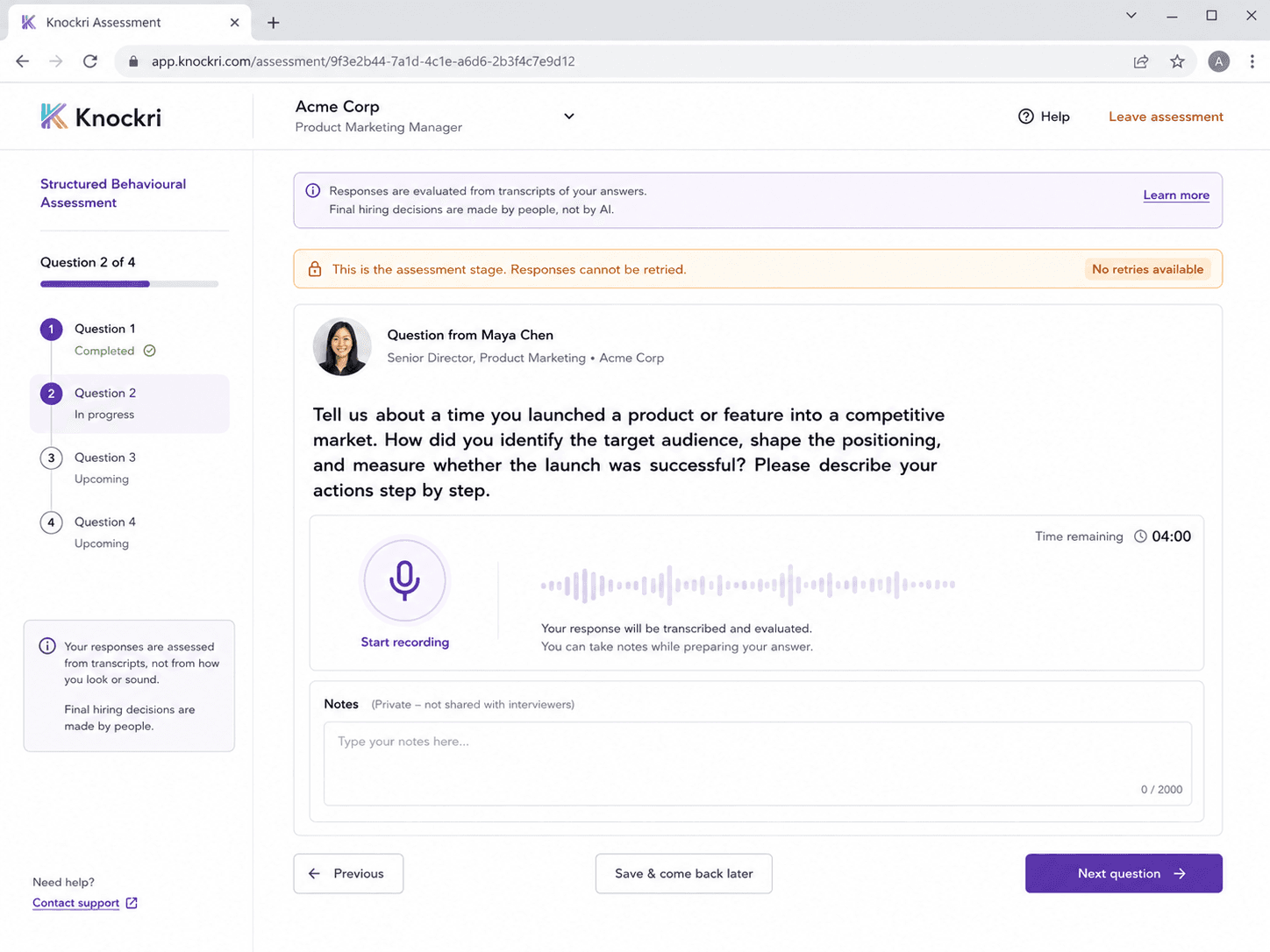
A Knockri assessment rewards clear behavioural evidence, not vague claims about being a good teammate or hard worker.
How Knockri is different from HireVue
Knockri and HireVue can both appear in early screening, but candidates should not treat them exactly the same.
HireVue is often discussed as a one-way video interview platform. Knockri is more specifically positioned around structured behavioural assessment, skills, competencies, and transcript-based evaluation.
That means your preparation should be different.
| Platform concern | What candidates often focus on | Better focus for Knockri |
|---|---|---|
| Camera presence | Eye contact, lighting, facial expression | Clear spoken content |
| Answer style | Sounding confident on video | Showing specific behaviours |
| Scoring concern | "How do I beat the AI?" | "Did I demonstrate the skill?" |
| Preparation | Rehearsing common video answers | Building a skill-based story bank |
| Delivery | Looking polished | Speaking clearly and step by step |
Do not ignore delivery. You still want to speak clearly, use a quiet room, and avoid rushing. But the biggest improvement will come from better answer content.
What Knockri is really assessing
Knockri-style assessments are usually built around skills and behaviours. The employer is not just asking, "Do we like this person?" They are trying to evaluate whether your past actions show evidence of the competencies needed for the role.
Common competencies can include:
- Communication
- Teamwork
- Problem-solving
- Adaptability
- Leadership
- Customer focus
- Initiative
- Accountability
- Judgment
- Empathy
- Resilience
- Planning
- Conflict resolution
- Learning agility
A weak answer says the skill name.
A strong answer proves the skill through behaviour.
Weak:
"I am very adaptable and I work well under pressure."
Better:
"When our launch timeline moved up by two weeks, I first listed the tasks that had to be done before release, then separated them into must-have and nice-to-have items. I spoke with engineering and support to understand the biggest risks, then proposed a smaller launch scope. We shipped the core workflow on time and moved the lower-priority changes into the next sprint."
The better answer does not just claim adaptability. It shows prioritization, communication, judgment, and ownership.
That is what you want in a Knockri answer.
The best answer structure for Knockri
For Knockri, use a structure that is stronger than basic STAR.
Use this:
- Name the situation.
- Explain the challenge.
- Describe what you personally did, step by step.
- Share the result.
- Name the skill your story proves.
This works well because Knockri-style questions often ask about past experiences. The platform is trying to identify behaviours in your answer, so your actions need to be explicit.
The Knockri answer formula
Situation: What was happening?
Challenge: What made it difficult?
Action: What did you personally do?
Result: What changed?
Skill: What does this show about how you work?
The most important part is the action. Do not rush through it.
Bad action section:
"I communicated with the team and solved the problem."
Better action section:
"I scheduled a 15-minute call with the designer and engineer, wrote down the two options we were debating, asked each person what risk they were most worried about, and then proposed a smaller version that protected the deadline."
The better version gives behaviours a reviewer can score.
Common Knockri interview questions
Knockri questions are usually behavioural. They ask about your previous experiences, not abstract opinions.
You may see questions like these.
Tell me about a time you overcame a challenge
This question tests problem-solving, resilience, and ownership.
A strong answer should include:
- What made the challenge difficult.
- What you tried first.
- What you changed when the first approach was not enough.
- What the outcome was.
- What you learned.
Example structure:
I faced this challenge when...
The hard part was...
My first step was...
Then I...
The result was...
This showed me...
Avoid turning this into a motivational story. Keep it practical.
Describe a time you helped someone
This question tests empathy, teamwork, and service orientation.
A strong answer should show what the other person needed and how you adapted your support.
Weak:
"I always help my teammates when they need support."
Better:
"A teammate was struggling to understand why a customer report kept changing week to week. I sat with them, walked through the data source, showed them where the logic was different, and then created a short checklist they could use before sending the report. After that, they were able to handle the report without needing review."
This answer works because the help is specific.
Tell me about a time you worked with a difficult stakeholder
This tests communication, conflict handling, and maturity.
The safest answer is not the most dramatic one. Choose a real disagreement where you behaved professionally.
Use this structure:
The disagreement was about...
Their concern was...
My concern was...
I handled it by...
We ended up...
Do not make the other person look stupid. The assessment is partly about how you handle people when work gets uncomfortable.
Tell me about a time you made a mistake
This tests accountability.
Pick a mistake that is honest but not fatal for the role. Then focus on what you changed.
Strong mistake answers include:
- What went wrong.
- Your role in it.
- How you fixed or contained it.
- What process you changed after.
- How you avoided repeating it.
Do not spend the whole answer apologizing. The useful part is the correction.
Tell me about a time you had to learn something quickly
This tests learning agility.
A strong answer should show your method, not just your effort.
Mention how you learned:
- Documentation
- A mentor or teammate
- Examples from past work
- Practice
- Testing
- Feedback
- Breaking the problem into parts
A good answer might sound like:
"I had to learn a new reporting tool in one week because our team was moving away from spreadsheets. I started by rebuilding one report I already understood, so I could compare the output. Then I watched two internal training videos, asked a senior analyst to review my first version, and documented the three mistakes I made. By the end of the week, I had rebuilt the report and created a short guide for the rest of the team."
That answer shows learning process, not just willingness.
Tell me about a time you took initiative
This tests ownership.
The key is to show that nobody had to tell you every step.
Strong initiative answers often include:
- You noticed a problem.
- You understood why it mattered.
- You took a reasonable first step.
- You involved the right people.
- You created a useful outcome.
Avoid examples where the "initiative" was just doing your assigned work.
How to prepare for a Knockri assessment
The best preparation is not memorizing answers. Knockri itself recommends speaking naturally. But natural does not mean unprepared.
You should prepare your evidence, not your script.
Step 1: Identify the skills the role probably cares about
Start with the job description.
Look for repeated signals. If the posting mentions customers five times, expect customer-focused questions. If it mentions ambiguity, expect questions about change, prioritization, or problem-solving. If it mentions collaboration, expect teamwork and conflict questions.
Use this table.
| Job posting signal | Skill being tested | Likely Knockri question |
|---|---|---|
| "Work cross-functionally" | Collaboration | Tell me about a time you worked with others to solve a problem. |
| "Fast-paced environment" | Adaptability | Tell me about a time priorities changed quickly. |
| "Customer-focused" | Empathy and judgment | Tell me about a time you helped a customer or user. |
| "Own projects end to end" | Accountability | Tell me about a time you took initiative. |
| "Use data to make decisions" | Analytical thinking | Tell me about a time you used information to solve a problem. |
| "Handle confidential information" | Integrity | Tell me about a time you had to make a responsible decision. |
| "Improve processes" | Problem-solving | Tell me about a time you made something more efficient. |
This gives you a realistic question map before you practice.
Step 2: Build a skill-based story bank
Prepare 6 to 8 stories. Each story should be flexible enough to answer multiple questions.
Use this format:
Story name:
Situation:
Challenge:
What I did:
Result:
Skills shown:
Example:
Story name: Fixed onboarding drop-off
Situation: New users were signing up but not completing setup
Challenge: Product, support, and sales had different theories
What I did: Pulled funnel data, reviewed support tickets, grouped issues, proposed two onboarding changes
Result: Setup completion improved and support tickets dropped
Skills shown: Analysis, customer focus, collaboration, ownership
This story could answer:
- Tell me about a time you solved a problem.
- Tell me about a time you used data.
- Tell me about a time you worked with different teams.
- Tell me about a time you improved a process.
- Tell me about a time you helped customers.
That is the goal. Build reusable evidence.
Step 3: Prepare your answer openings
Many candidates waste the first 20 seconds figuring out how to start.
Prepare simple openings.
For a challenge question:
"One challenge I faced was..."
For a teamwork question:
"A good example is a project where I worked with..."
For a mistake question:
"One mistake I made was..."
For an initiative question:
"I took initiative when I noticed..."
These openings are not scripts. They just prevent a messy start.
Step 4: Practice out loud
Silent preparation does not work for Knockri.
You need to hear whether your answer is clear. You need to know whether you ramble. You need to practice explaining your actions step by step without sounding robotic.
Use CareerMax Interview Prep to create a screening round simulation for the target role. Paste the job description, choose the screening round format, and practice answering behavioural questions out loud. CareerMax helps you check whether your answer has enough structure, specificity, role fit, and evidence.
This is especially useful for Knockri because your response needs to stand on its own. There may not be a live interviewer to ask, "Can you give me an example?" or "What exactly did you do?"
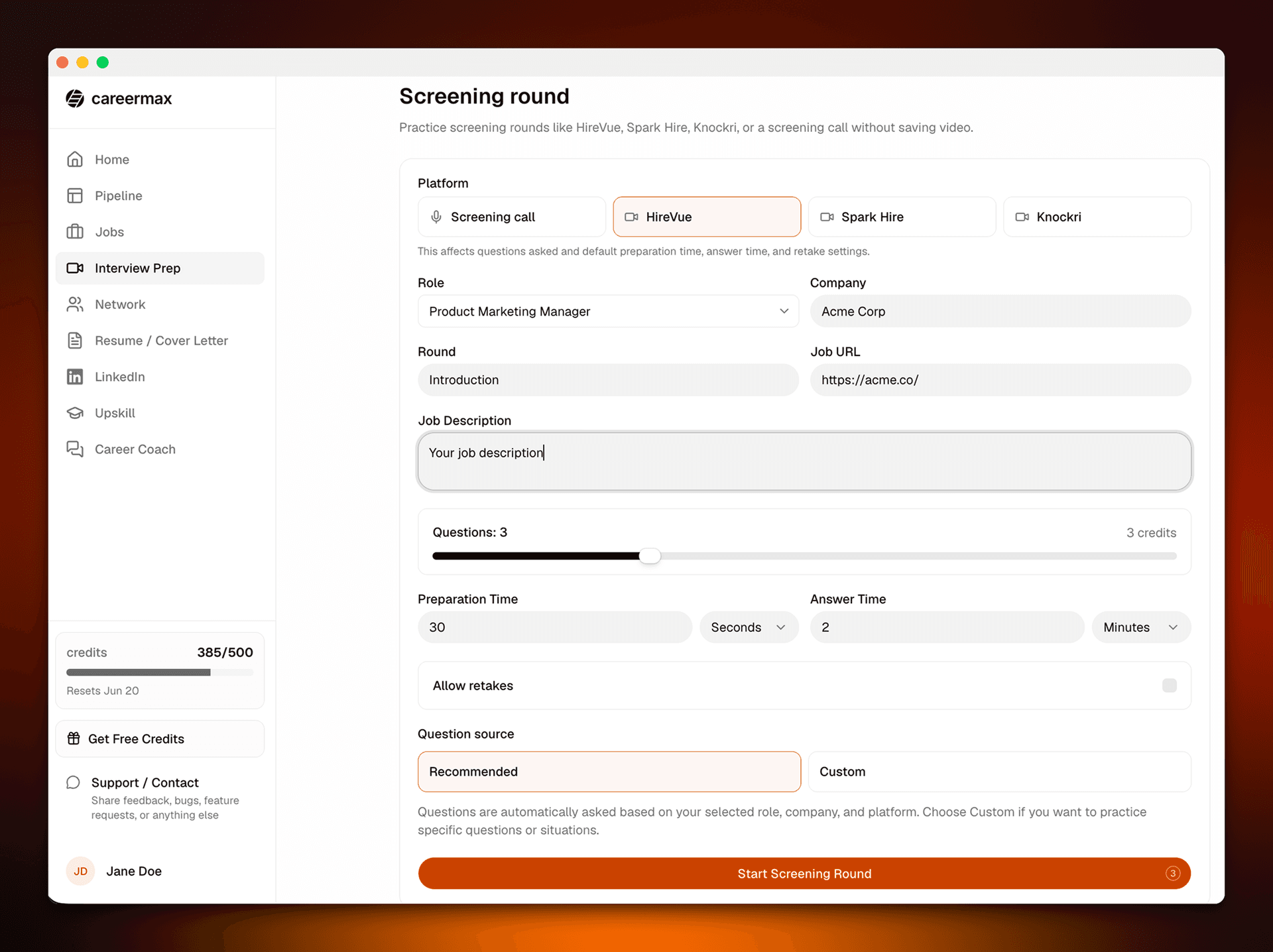
Use CareerMax to create a role-specific screening round simulation before starting your Knockri assessment.
Step 5: Do the practice questions inside Knockri
If the platform gives you practice questions, use them.
This is not just for calming your nerves. Use the practice stage to check:
- Does your microphone work?
- Can you hear yourself clearly?
- Are you speaking too fast?
- Are you using the notes section effectively?
- Are you comfortable with the question flow?
- Do you understand when the real assessment starts?
Do not treat the practice question as a throwaway. It is your rehearsal for the platform mechanics.
How to answer so your transcript is strong
Because Knockri focuses on what you say, your answer should be easy to understand as text.
That changes how you speak.
Use names for the skill
You can mention the skill naturally.
Example:
"This showed problem-solving because I did not just patch the issue. I found the root cause and changed the process so the problem would not repeat."
Do not stuff skill words into every sentence. Just make the connection obvious.
Make your personal role clear
In team stories, candidates often say "we" too much.
Use "we" for the group outcome, but use "I" for your contribution.
Weak:
"We solved the issue and launched on time."
Better:
"The team launched on time. My role was to identify the reporting issue, rebuild the dashboard, and explain the change to the sales team."
Knockri needs to evaluate your behaviour, not just the team's result.
Describe steps in order
For behavioural assessments, sequence helps.
Instead of saying:
"I communicated with everyone and handled it."
Say:
"First, I clarified the deadline. Then I listed the risks. After that, I spoke with the two teams most affected and proposed a smaller launch scope."
Step-by-step answers are easier to follow and easier to score.
Include the result
A result does not always need a big number.
Good results include:
- Finished before the deadline.
- Reduced errors.
- Improved customer response time.
- Helped a teammate work independently.
- Prevented an escalation.
- Created a process the team reused.
- Improved a metric.
- Learned a lesson and changed your approach.
If there was no perfect outcome, explain what improved.
Avoid vague personality claims
Do not rely on phrases like:
- "I am a team player."
- "I am hardworking."
- "I communicate well."
- "I am passionate."
- "I am a fast learner."
- "I always go above and beyond."
Those can be true, but they are not evidence.
Replace the claim with behaviour.
Instead of:
"I am a fast learner."
Say:
"I learned the tool by rebuilding a report I already understood, comparing the outputs, asking for review, and documenting the mistakes I made."
That is much stronger.
What to write in your notes
Knockri recommends taking notes during the assessment. Notes are useful, but only if they are short.
Do not write a full script. Reading a script can make your answer stiff and can slow you down.
Use notes like this:
Story: onboarding issue
Problem: users dropped before setup
Action: data, tickets, 2 fixes
Result: completion up, tickets down
Skill: customer focus + analysis
That is enough to keep you on track.
For each answer, write only:
- Story name
- Main problem
- Three action words
- Result
- Skill
If your notes are longer than that, you may end up reading instead of answering.
How long should Knockri answers be?
Use the time limit given inside your assessment. If you are not sure, aim for a complete answer that is long enough to show evidence but not so long that it becomes repetitive.
For most behavioural questions, a good answer is usually 90 to 150 seconds.
That gives you enough time to cover:
- Situation
- Challenge
- Action
- Result
- Skill connection
If you finish in 25 seconds, you probably did not give enough detail. If you keep running out of time, your setup is too long.
A useful timing split:
| Answer part | Target |
|---|---|
| Situation | 10 to 20 seconds |
| Challenge | 10 to 20 seconds |
| Action | 40 to 70 seconds |
| Result | 15 to 30 seconds |
| Skill connection | 10 to 20 seconds |
Spend the most time on what you did.
Technical setup checklist
Before you begin, set up your environment properly.
- Use Chrome, Firefox, or Safari.
- Check your internet connection.
- Use a quiet room.
- Test your microphone.
- Test your webcam if the assessment asks for it.
- Close Slack, WhatsApp, email, and other notifications.
- Plug in your laptop.
- Keep water nearby.
- Keep a pen and paper ready.
- Read all instructions before starting.
- Complete the practice questions before the real assessment.
If your internet is unstable, do not start from a weak connection unless you have no other option. Technical stress will make your answers worse.
What to do if you get nervous
Knockri says it is okay to pause, collect your thoughts, or restart a sentence. That matters.
You do not need to sound perfect. You need to be understandable.
If your mind goes blank, use this reset:
The situation was...
What made it difficult was...
What I did was...
The result was...
That simple structure can rescue most behavioural answers.
If you stumble, do not apologize repeatedly. Just continue.
Bad:
"Sorry, sorry, I messed that up. Let me start again. Sorry."
Better:
"Let me restate that clearly. The main challenge was..."
A calm correction is fine.
Mistakes to avoid in a Knockri interview
Giving a generic answer
Generic answers are the biggest risk.
Weak:
"I helped my team by communicating clearly and staying positive."
Better:
"I helped my team by creating a shared tracker, setting a daily 10-minute check-in, and summarizing blockers for the manager so decisions were made faster."
The second answer gives behaviours.
Talking too much about the background
Context matters, but only enough to understand the action.
If your answer spends one minute explaining the company, team history, and project background, you are wasting time.
Get to the action quickly.
Forgetting what you personally did
Knockri is evaluating your response. Do not hide behind "we."
A good team answer should still make your contribution clear.
Trying to sound like a perfect candidate
Over-polished answers can sound fake.
Use real examples. Mention real tradeoffs. If something did not go perfectly, explain how you handled it.
Hiring teams trust realistic answers more than motivational speeches.
Ignoring the job description
Your best story is not always the most impressive story. It is the story that best proves the skill the role needs.
For a customer support role, a story about calming down a frustrated customer may beat a bigger project story. For an analyst role, a story about finding a data issue may beat a generic leadership example.
Match the answer to the role.
Waiting until the real assessment to speak out loud
Do not make the actual Knockri assessment your first spoken practice round.
Practice with CareerMax, your laptop camera, or voice notes first. You will catch problems quickly:
- Answers that are too vague.
- Stories with no result.
- Too much background.
- Weak endings.
- Repeating the same phrase too often.
- Speaking too fast.
One practice round can make the real assessment feel much less awkward.
45-minute Knockri prep plan
If your Knockri assessment is due soon, use this plan.
First 10 minutes: read the job posting
Write down the top 5 skills the role needs.
Example:
Communication
Problem-solving
Customer focus
Teamwork
Adaptability
Next 15 minutes: choose your stories
Pick 5 stories that cover those skills.
Use this quick grid:
| Skill | Story |
|---|---|
| Communication | Explained dashboard issue to sales team |
| Problem-solving | Fixed broken reporting process |
| Customer focus | Resolved repeated onboarding complaint |
| Teamwork | Worked with design and engineering on launch |
| Adaptability | Adjusted plan after timeline changed |
Next 15 minutes: practice 3 answers out loud
Practice one challenge answer, one teamwork answer, and one mistake answer.
Record yourself if possible. Listen for one thing only: are your actions clear?
Final 5 minutes: prepare your setup
Check your microphone, browser, internet, notes, and invitation instructions.
Do not use the last five minutes to rewrite all your answers.
FAQ: Knockri interviews
How do I pass a Knockri interview?
To pass a Knockri interview, prepare specific behavioural examples, answer in a clear step-by-step structure, explain what you personally did, and connect your story to the skill the role requires. Practice out loud before the assessment so your answers are clear under time pressure.
What questions are asked in a Knockri interview?
Knockri questions are usually behavioural. Common examples include "Tell me about a time you overcame a challenge," "Describe a time you helped someone," "Tell me about a time you worked with a team," "Tell me about a time you made a mistake," and "Tell me about a time you had to learn something quickly."
Does Knockri analyze my face or accent?
Knockri says it evaluates your skills based on what you say in your responses. For candidates, the practical takeaway is to focus less on trying to look perfect and more on giving clear, specific, role-relevant answers.
Can I retry my Knockri answers?
Practice questions may be retryable while the practice stage is active. Real assessment responses usually cannot be reviewed or retried after submission. Treat the practice stage seriously so you are comfortable before the real questions begin.
Should I memorize answers for Knockri?
No. Memorized answers often sound stiff and may not match the exact question. Prepare story bullets instead. Know the situation, action, result, and skill for each story, then answer naturally.
How long should my Knockri answer be?
Follow the time limit shown in your assessment. For most behavioural questions, aim for 90 to 150 seconds. Shorter answers may lack evidence, while longer answers can become repetitive.
What technology do I need for a Knockri assessment?
Use a stable internet connection and a supported browser such as Chrome, Firefox, or Safari. Before starting, test your microphone and webcam if required.
Can I take a break during Knockri?
You may be able to leave before or after questions, or during the practice stage, depending on your assessment setup and link expiry rules. Read your invitation instructions carefully before starting.
How can I practice for a Knockri interview?
Use CareerMax Interview Prep to create a screening round simulation based on your target role and job description. Practice behavioural questions out loud, review whether your answers show enough evidence, and repeat until your stories are clear.
The bottom line
A Knockri interview is not about sounding clever. It is about giving clear evidence.
Read the job description. Identify the skills. Build a story bank. Practice out loud. In the real assessment, explain what you personally did, step by step, and connect it to the role.
Before you start the real Knockri assessment, run a screening round simulation in CareerMax Interview Prep. It gives you the practice most candidates skip, and that practice makes your real answer much easier to deliver.
Last updated: June 2026