Free Resume Templates Are Only Step One: How to Turn a Template Into Interviews
Key takeaways
- A resume template solves structure, not strategy. The best applications still need role-specific positioning.
- Layout matters because recruiters and ATS systems both need predictable sections, clean dates, readable bullets, and clear evidence.
- Choose a template based on the hiring screen you are trying to pass, not the design you like most.
- Build a proof bank before tailoring so every application draws from real projects, tools, metrics, and outcomes.
- CareerMax is most useful after the base resume exists: tailoring resumes, writing cover letters, tracking applications, finding referrals, and applying to relevant jobs.
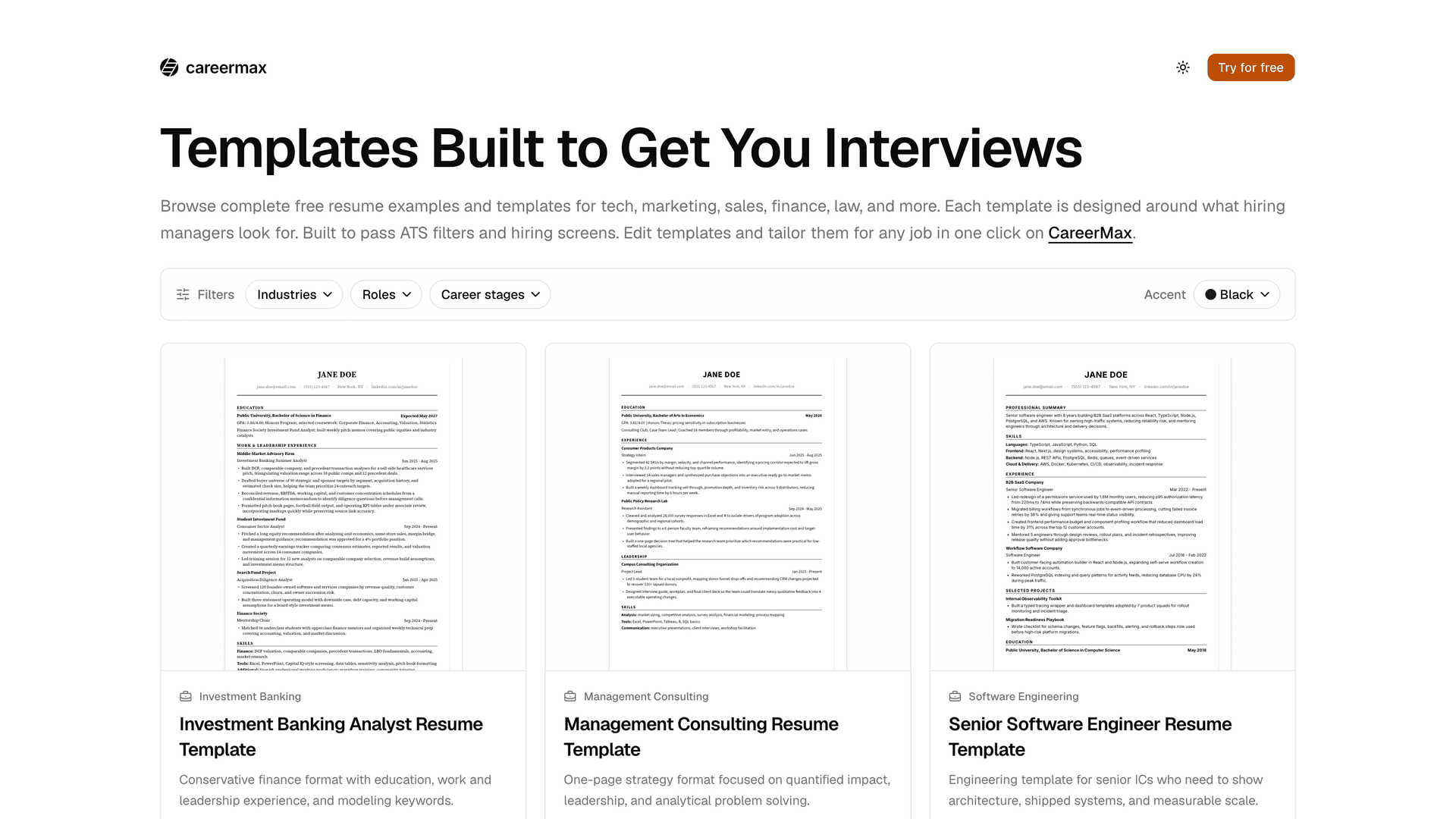
We just launched free resume templates on CareerMax.
They are editable, downloadable, and built for specific roles and career stages: investment banking, consulting, software engineering, data science, product, marketing, sales, accounting, nursing, federal jobs, law, teaching, internships, career changes, return-to-work searches, and more.
That solves a real problem. A blank page is painful, and most resume templates on the internet are either too generic, too decorative, or too thin to teach you what a strong resume should actually contain.
But a template is not the whole job.
A good template gives you the right frame. It gives you section order, spacing, examples, and a format that should be easy to scan. It cannot decide which evidence matters for a specific job description. It cannot know whether a recruiter needs to see modeling experience, patient ratios, system scale, classroom outcomes, quota attainment, or federal specialized experience in the first few seconds.
That part still needs judgment.
This guide is about how to use templates properly: not as a prettier document, but as the start of a better application system.
What A Resume Template Can Do
A strong resume template should make the basics hard to mess up.
It should give you a clean structure, standard section names, readable spacing, and example bullets that show the level of specificity expected in your field. It should also keep you away from formatting choices that look interesting on a screen but become risky when parsed by applicant tracking systems.
That means:
- One primary column
- Conventional headings like Experience, Education, Skills, Projects, and Certifications
- Consistent dates and job titles
- Bullets that are easy to skim
- No photos, skill bars, decorative icons, or layout tricks that make the document harder to read
- Enough whitespace to scan, but not so much that the resume looks empty
The best resume layout usually feels almost invisible. The reader should notice the evidence, not the container.
That does not mean design is irrelevant. Format changes what the reader sees first. It controls whether the page feels dense or light, senior or junior, technical or general, conservative or creative. Good design lowers the effort required to understand you.
Bad design creates work for the person deciding whether to call you.
What A Template Cannot Do
The biggest mistake is treating a template as the final answer.
No template can know the exact role you are applying for. It cannot read the job description, compare it against your background, and decide which parts of your experience should move up, down, expand, or disappear.
It also cannot turn vague experience into persuasive evidence on its own.
For example, a template can give you a line that says:
Improved reporting process for leadership team.
That is a starting point, not a finished bullet.
The useful version might be:
Rebuilt weekly revenue reporting for a 6-person leadership team, reducing manual updates from 5 hours to 45 minutes and giving managers a single view of pipeline, churn, and expansion.
The second bullet works because it gives the reader something concrete to evaluate. It shows audience, scope, work performed, and result. Even if your numbers are smaller, the principle holds. A resume should make your work legible.
Choose The Template Based On The Hiring Screen
Do not start by asking, "Which template looks best?"
Start by asking, "Who is going to screen this resume, and what are they trained to look for?"
An investment banking analyst resume has different rules than a new grad nursing resume. A federal resume has different expectations than a product manager resume. A research CV is not trying to do the same job as a one-page sales resume.
That is why CareerMax templates are organized by role, industry, and career stage. The format should match the evaluation context.
For example:
- Finance screens often reward a conservative, dense, one-page resume with education, GPA, finance leadership, modeling, valuation, and transaction exposure easy to verify.
- Software engineering screens need shipped systems, architecture decisions, scale, languages, frameworks, reliability, and ownership.
- Nursing resumes should foreground licensure, certifications, clinical rotations, unit type, patient care scope, EHR tools, and measurable care or quality contributions.
- Federal resumes need exact fields and announcement language, including specialized experience, hours per week, dates, series, grade, and government-style detail.
- Career-change resumes need to connect transferable experience to a target role without pretending the transition is obvious.
The same person might need different versions of their resume for different hiring screens.
That is not dishonest. It is communication.
Build A Proof Bank Before You Tailor Anything
Most people try to tailor a resume by staring at the job description and rewriting bullets from scratch.
That is slow, and it usually produces generic language.
A better approach is to build a proof bank first. This is a private document with all the raw material you might use across applications.
Collect:
- Projects you worked on
- Metrics you influenced
- Tools, systems, platforms, and methods you used
- Teams, customers, patients, accounts, budgets, or systems you supported
- Problems you solved
- Constraints you worked under
- Decisions you made
- Before-and-after outcomes
- Awards, certifications, publications, presentations, or leadership examples
- Stories you could defend in an interview
Do not worry about making this polished. The point is to make your evidence available.
Once the proof bank exists, tailoring becomes selection. You are not inventing a new version of yourself for every application. You are choosing the most relevant proof for the role in front of you.
Tailor The Argument, Not Your Identity
The word "tailoring" makes some job seekers uncomfortable because it sounds like spin.
It should not be spin.
Tailoring means changing the argument your resume makes.
If one job description emphasizes lifecycle marketing, your resume should bring segmentation, retention, experimentation, CRM, and campaign results closer to the top.
If another emphasizes analytics, the same candidate may lead with SQL, dashboards, funnel analysis, forecasting, and decision support.
If a software engineering role is infrastructure-heavy, systems reliability and scale should get more space than frontend polish. If the role is product engineering, shipped features, user impact, and cross-functional work may matter more.
Same career. Different emphasis.
A practical tailoring pass usually touches four places:
- The headline or summary
- The order of skills
- The first one or two bullets under recent roles
- Any project, certification, or accomplishment that maps directly to the job description
You do not need to rewrite the whole resume every time. You do need to make sure the first page answers the employer's actual question.
Use Keywords Where They Belong
ATS optimization is often explained badly.
Job seekers hear "keywords" and assume the resume needs a skills dump. That is how you get a document full of disconnected terms:
Python, SQL, leadership, strategy, dashboards, communication, problem-solving, analytics.
That might help a weak parser notice a few words, but it does not help a recruiter understand whether you have used those skills in real work.
The better move is to attach important keywords to proof.
If the job asks for SQL, show the dashboard, analysis, model, or workflow where you used SQL.
If the role asks for stakeholder management, show who the stakeholders were and what changed because of your work.
If the investment banking posting asks for DCF, comparable company analysis, and pitch books, show where those tools appeared in a project, internship, student fund, transaction advisory role, or finance club experience.
Use the employer's language when it is accurate. Do not add skills you cannot defend. A resume that gets past software but fails the first technical or behavioral question has not helped you.
Write The Cover Letter After The Resume
A cover letter is easiest to write after the resume is tailored.
If the resume is still generic, the cover letter becomes generic too. It repeats your background, adds a few sentences about being excited, and does not change the employer's understanding of you.
A useful cover letter does a different job. It explains the match.
It can add context the resume cannot fully carry:
- Why this role is the next logical step
- Why a career change makes sense
- Why your industry experience transfers
- Why you are interested in that company or team
- How your strongest projects map to the job's problems
- Why a gap, relocation, or nontraditional path should not distract from your fit
The cover letter should not be a second resume. It should be the connective tissue between the job description and your most relevant proof.
CareerMax can generate cover letters from the tailored version of your resume, which is the right order. Resume first, letter second.
Treat Applications Like A Workflow
A resume is only one part of the application.
The stronger workflow looks like this:
- Pick the closest role-specific template.
- Build a clean base resume.
- Create a proof bank of projects, metrics, tools, and stories.
- Read the job description and identify the 3 to 5 requirements that matter most.
- Tailor the summary, skills, and top bullets around those requirements.
- Check formatting, ATS readability, keywords, impact language, and role alignment.
- Generate a cover letter from the tailored resume.
- Apply early when possible.
- Track the application, follow-up date, and next action.
- Look for a referral or warm connection if the company matters to you.
This is where CareerMax becomes more useful than a template library.
You can use the templates for free. When you want to move beyond the base document, CareerMax can help tailor the resume to a specific role, generate the matching cover letter, score the resume across key dimensions, track applications, find referrals, practice interviews, and apply to curated jobs with materials customized for each role.
The point is not to automate thoughtless mass applications. The point is to remove repetitive work while keeping the application relevant.
A Quick Resume Template Checklist
Before you download or submit your resume, run through this list:
- Is the template appropriate for the role, industry, and seniority level?
- Can the reader understand your target role within a few seconds?
- Are the section names standard enough for ATS software and recruiters?
- Does the top third contain your strongest role-specific evidence?
- Are your bullets written as accomplishments, not responsibilities?
- Do important keywords appear inside real experience, not only in a skills block?
- Are the layout, spacing, and file format boring in the right ways?
- Is the resume tailored to this job description?
- Does the cover letter explain the match instead of repeating the resume?
- Do you know where the application is tracked and what happens next?
Start With The Free Templates
If you need a better starting point, browse the free CareerMax resume templates.
Pick the template closest to the hiring screen you are trying to pass. Edit it. Download it. Use it as a base.
Then do the part that actually changes outcomes: tailor the resume for the role, connect the cover letter to the tailored version, apply with intent, and track the process so every application teaches you something.